
Staq upgrade leading to massive speed boost
We have massive news to share — something that has been 1.5 years in the making.
We’ve completely re-engineered how scripts load and execute across NGINX, PHP and Redis Object Cache — the core layers that determine how fast your WordPress sites actually run.
But we didn’t just optimise for today. We’ve improved the platform in a way that positions us for what’s coming next — including better support for AI-driven workloads and the tools agencies will need as the industry evolves.
This isn’t a cosmetic upgrade.
It’s a fundamental change focused on:
Execution efficiency, scalability, and real-world WordPress performance.
This upgrade is now live across all sites on WPStaq.
Key Takeaways
This upgrade wasn’t about changing WordPress, installing plugins, or upgrading hardware.
It was about rebuilding how WPStaq executes and delivers requests.
Across real-world testing on the same site and the same infrastructure class we measured:
- Up to 35% faster PHP execution
- Up to 42% faster cached page delivery
- Up to 38% faster WordPress AJAX round-trips
- Up to 37% faster internal PHP processing
- Up to 25% faster dynamic pages with Redis
- Dramatically improved response consistency — spread reduced from 2.9× to 1.2×
- PHP 8.5 availability on the new platform
The result is simple:
Faster page generation. Faster PHP workers. Better stability under load. And a platform that scales far more efficiently.
The Website We Tested
We didn’t benchmark a blank WordPress install.
We used a real WooCommerce website running 33 active plugins, including:
- Accelerated Mobile Pages
- Advanced Custom Fields
- Ally – Web Accessibility & Usability
- Beaver Builder Plugin (Unlimited Version)
- Beaver Themer
- Cart Popup for WooCommerce
- Change WooCommerce Add to Cart Text
- Code Snippets
- Disable Comments
- Disable Gutenberg
- Duplicate Page
- Export and Import Users and Customers
- Formidable Datepicker Options
- Formidable Forms
- Formidable Forms Pro
- Formidable Mailchimp
- Formidable Visual Views
- GTranslate
- Head, Footer and Post Injections
- Heroic Favicon Generator
- Order Export & Order Import for WooCommerce
- Pixel Manager for WooCommerce
- PowerPack for Beaver Builder
- SOGO Add Script Header Footer
- Sticky Menu (or Anything!) on Scroll
- SVG Support
- Variation Price Display Range for WooCommerce
- WC Fields Factory
- WooCommerce
- WooCommerce Stripe Gateway
- WP Business Reviews
- WP Mail SMTP
- Yoast SEO
Same site. Same plugins. Same workload.
Because performance claims only matter if they reflect real WordPress environments.
How We Tested
No synthetic scripts.
No “hello world” benchmarks.
We measured real WordPress execution paths including:
- PHP execution via php-fpm
- admin-ajax.php requests
- Uncached page generation
- Cached page delivery via NGINX
- Redis Object Cache performance
- WordPress internal PHP execution (measured from inside PHP itself)
We tested across:
- Old infrastructure — PHP 7.4
- Old infrastructure — PHP 8.2
- New infrastructure — PHP 7.4
- New infrastructure — PHP 8.2
- New infrastructure — PHP 8.5
Each configuration was tested with Redis Object Cache enabled and disabled — giving us 10 full benchmark runs.
All requests were executed locally on the server.
Which means:
No CDN No network latency No geographic influence
This isolates the performance of the execution platform itself.
Testing With and Without Redis
To isolate infrastructure performance, we first ran all benchmarks with Redis Object Cache disabled.
This allowed us to measure the raw execution performance of:
- PHP
- SQL queries
- WordPress plugin execution
- NGINX delivery
After establishing the baseline, Redis was enabled and the tests were repeated.
Redis primarily improves scalability and concurrency, not necessarily the speed of a single cold request.
This means Redis helps most when:
- Many users hit the site simultaneously
- Database queries repeat
- PHP workers would otherwise become saturated
Same Hardware. Same Resources. Faster Engineering.
One of the most important aspects of this upgrade:
We did not upgrade hardware.
There were:
- No larger servers
- No additional CPUs
- No additional memory
Both old and new infrastructure were tested on identical AWS EC2 instances.
Instead, performance gains came from deep infrastructure optimisation, including:
- System-level tuning
- Improved request scheduling
- Improved NGINX configuration
- Networking optimisations
- More efficient worker orchestration
And because the hardware generation stayed the same, these improvements scale efficiently across every site on the platform.
Real PHP Execution Performance
We measured raw PHP execution using admin-ajax.php — one of the most common execution paths inside WordPress.
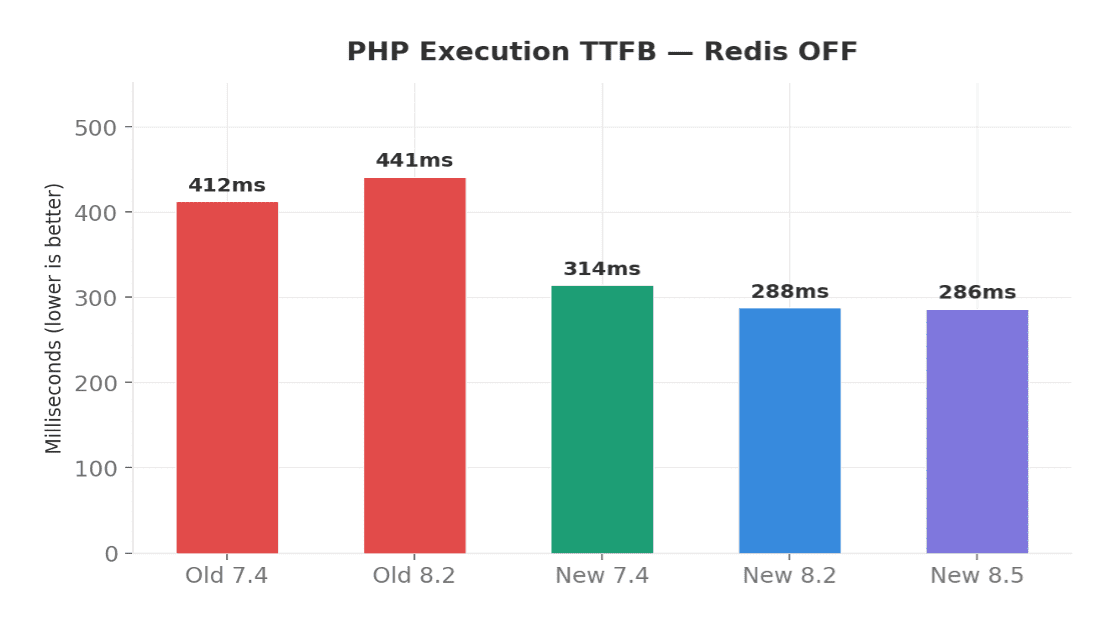
Without Redis
| Configuration | Average TTFB | vs Old Infra |
| Old 7.4 | 412ms | — |
| Old 8.2 | 442ms | — |
| New 7.4 | 314ms | 24% faster |
| New 8.2 | 288ms | 35% faster |
| New 8.5 | 286ms | 35% faster |
Running the exact same PHP version on the new infrastructure reduced execution time by up to 35%. This confirms the improvement comes from the execution platform itself, not just PHP upgrades.
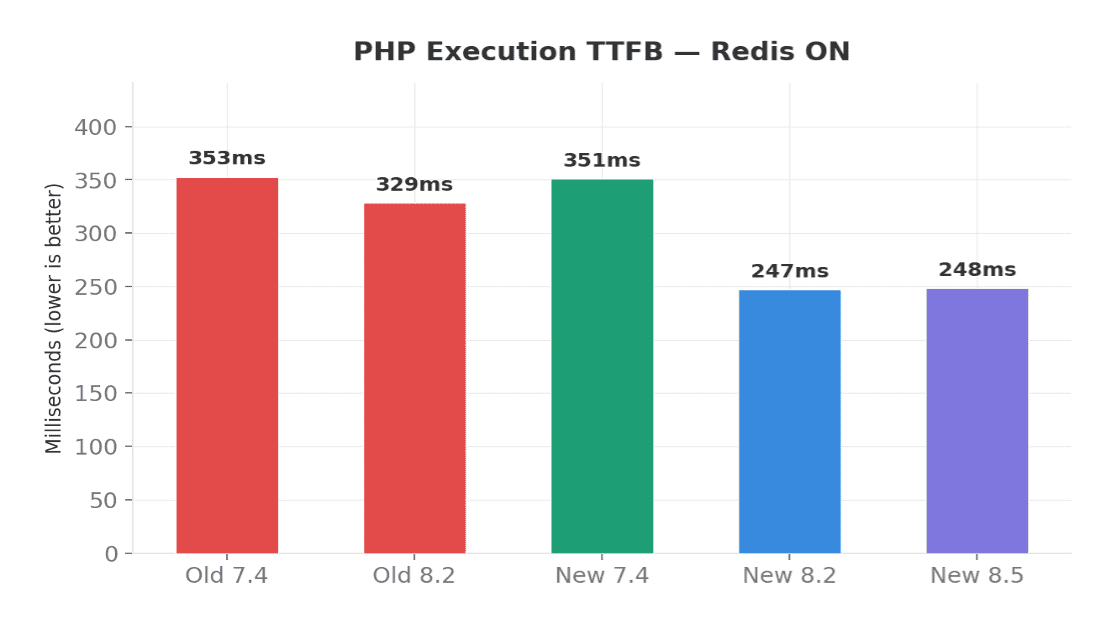
With Redis Enabled
| Configuration | Average TTFB | vs Old Infra |
| Old 7.4 | 353ms | — |
| Old 8.2 | 329ms | — |
| New 7.4 | 351ms | Equivalent |
| New 8.2 | 247ms | 25% faster |
| New 8.5 | 248ms | 25% faster |
On PHP 8.2 and 8.5 with Redis, execution drops to under 250ms — a 25% improvement over the old infrastructure.
The Hidden Win: Response Consistency
Averages only tell half the story. What they hide is the experience your visitors actually have.
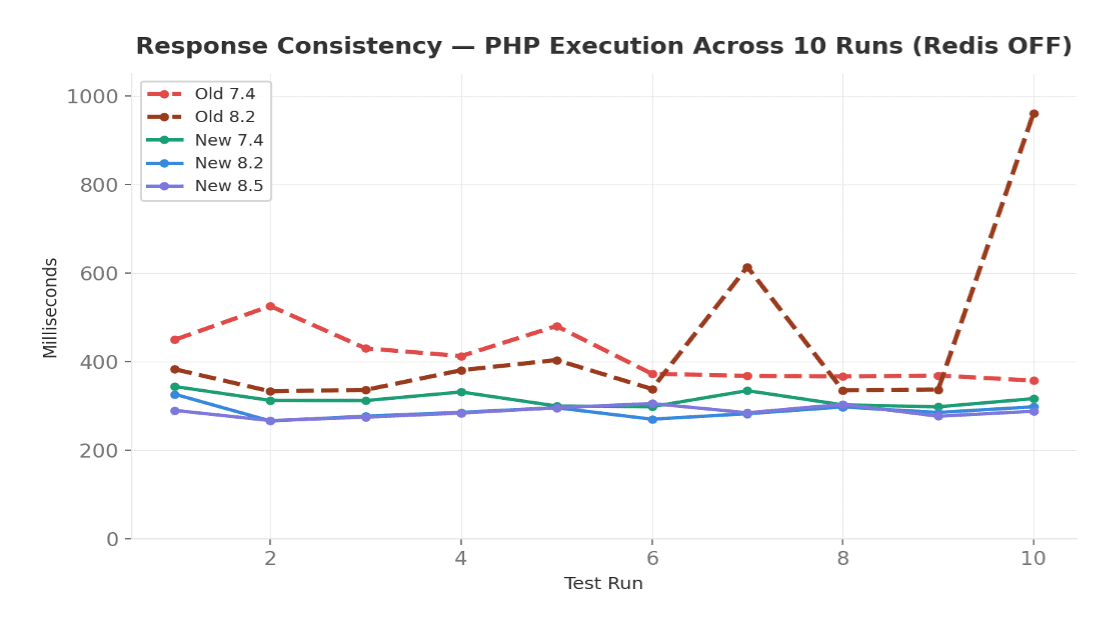
Look at the old infrastructure lines. On PHP 8.2, response times ranged from 332ms to 961ms across just 10 identical requests — a 2.9× swing.
Now look at the new infrastructure lines. Flat. Predictable. Consistent.
New 8.2 stayed between 265ms and 326ms — a 1.2× swing. New 8.5 was even tighter at 1.1×.
Response time variance reduced by up to 60%. No more random slow loads.
Every request is predictable. That’s what your visitors actually feel.
What This Means
Performance isn’t just about milliseconds.
The real metric is:
How quickly a PHP worker finishes and becomes available again.
If workers free up faster:
- More requests can be processed
- Fewer requests queue
- Traffic spikes are handled more smoothly
This is why the platform now handles load more efficiently even when raw execution time appears similar.
WordPress Backend Performance
We measured PHP execution time from inside the PHP process itself — using REQUEST_TIME_FLOAT to capture the full WordPress bootstrap including all 33 plugins.
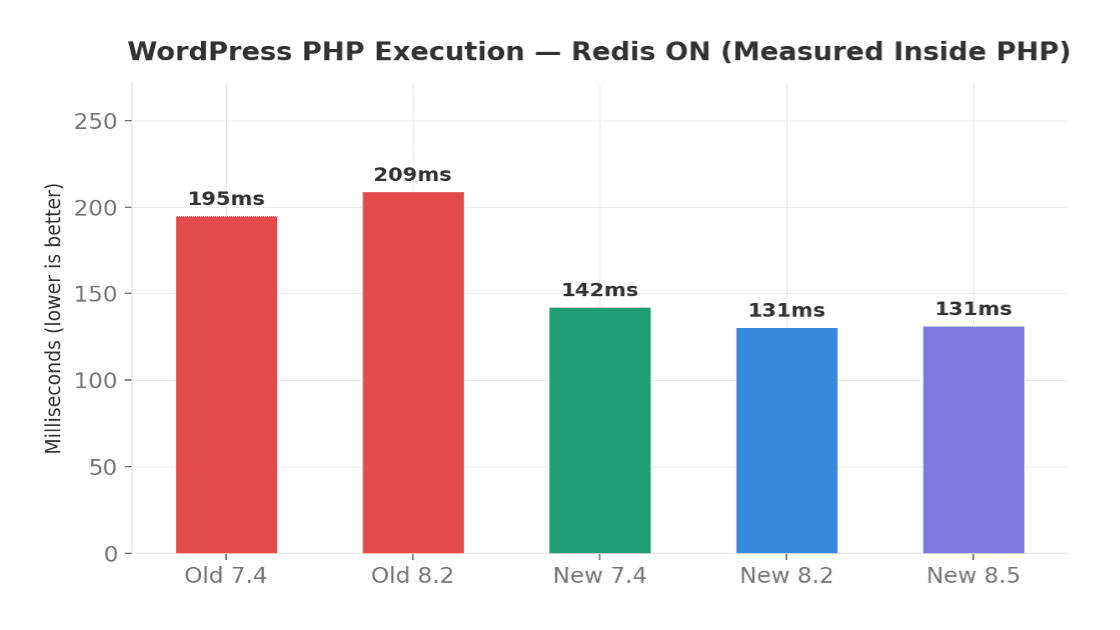
| Configuration | PHP Internal (Redis ON) | vs Old Infra |
| Old 7.4 | 195ms | — |
| Old 8.2 | 209ms | — |
| New 7.4 | 142ms | 27% faster |
| New 8.2 | 131ms | 37% faster |
| New 8.5 | 131ms | 37% faster |
Internal PHP execution dropped from 209ms to 131ms on the new infrastructure — a 37% improvement.
For agencies managing multiple sites, this means faster editing, quicker WooCommerce operations, and less waiting between actions.
Performance improvements aren’t just visible to visitors — they’re felt by the people managing the sites.
WordPress AJAX Frontend Performance
The AJAX benchmark measures the full round-trip — the closest measure to what a real browser experiences.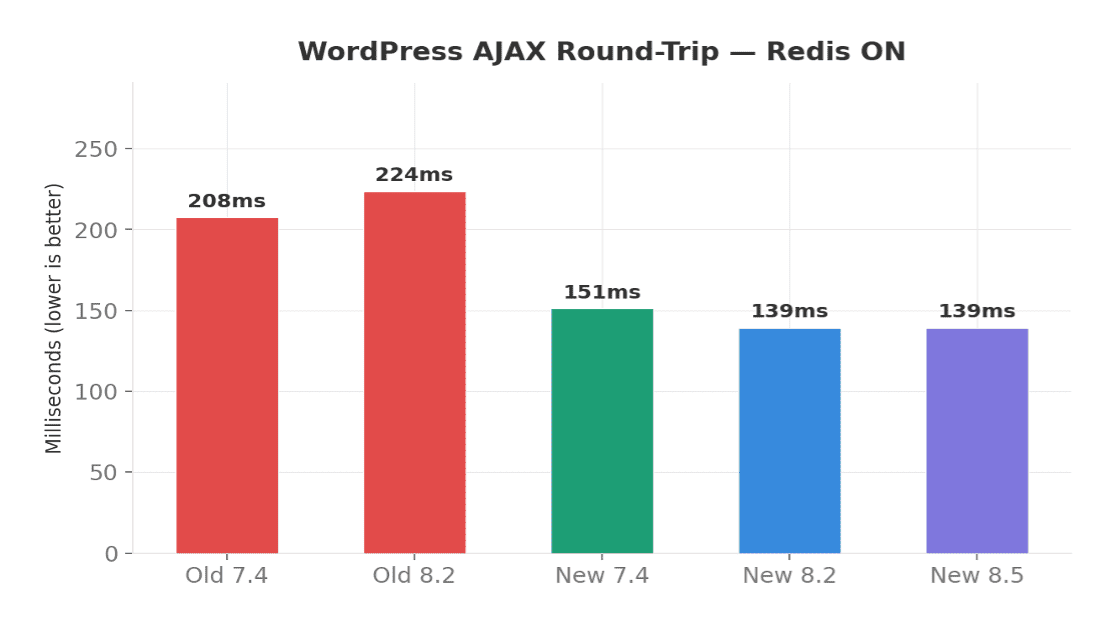
| Configuration | AJAX Round-Trip (Redis ON) | vs Old Infra |
| Old 7.4 | 208ms | — |
| Old 8.2 | 224ms | — |
| New 7.4 | 151ms | 27% faster |
| New 8.2 | 139ms | 38% faster |
| New 8.5 | 139ms | 38% faster |
Live search, cart popups, real-time filtering, form validation — anything that fires an AJAX request benefits directly. Up to 38% faster across the board.
Cached Page Delivery
Cached pages bypass PHP entirely and are served directly by NGINX.
This makes cached performance a direct reflection of the web server and networking layer.
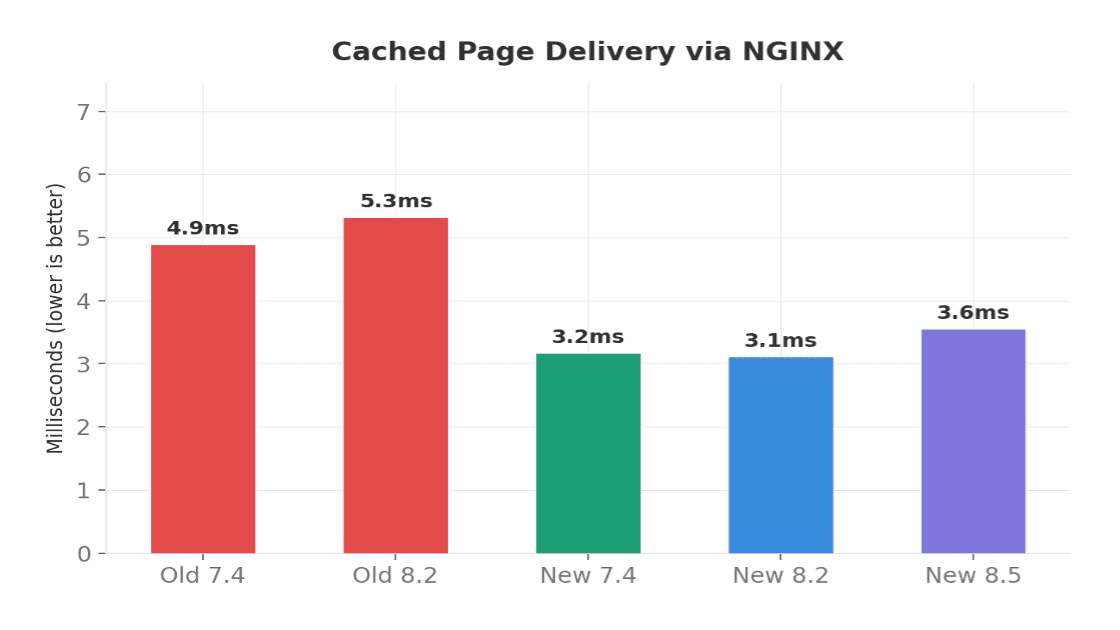
| Configuration | Cached TTFB | vs Old Infra |
| Old 7.4 | 4.9ms | — |
| Old 8.2 | 5.3ms | — |
| New 7.4 | 3.2ms | 35% faster |
| New 8.2 | 3.1ms | 42% faster |
| New 8.5 | 3.6ms | 33% faster |
Cached responses are now delivered in approximately 3ms — down from ~5ms on the old infrastructure. A 42% improvement in content delivery speed.
These improvements come from optimised NGINX configuration, kernel networking improvements, better connection handling, and improved request scheduling.
Uncached Page Generation
Dynamic pages require full WordPress execution — PHP boots, plugins load, database queries run, and the page assembles from scratch.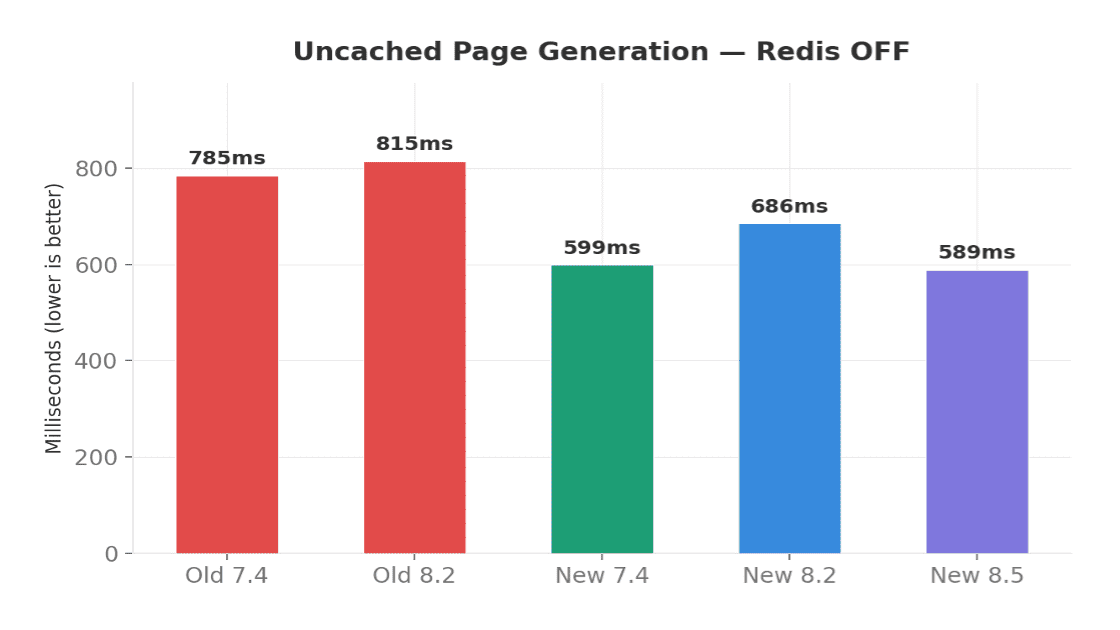
On PHP 7.4, uncached page generation improved by 24% (785ms → 599ms). On PHP 8.2, it improved by 16% (815ms → 686ms).
But the real story is underneath: while the total page time improves moderately, the PHP worker finishes faster and becomes available sooner. This means the server can handle more concurrent requests before workers start queuing.
Redis Object Cache Results
After baseline testing was completed, Redis Object Cache was enabled and all tests were repeated.
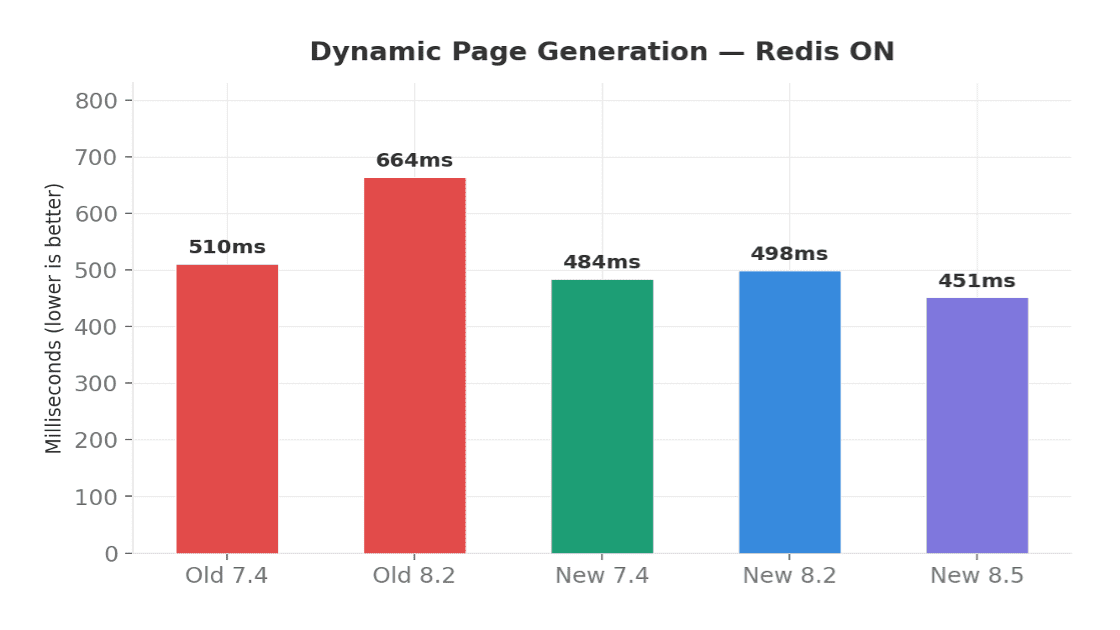
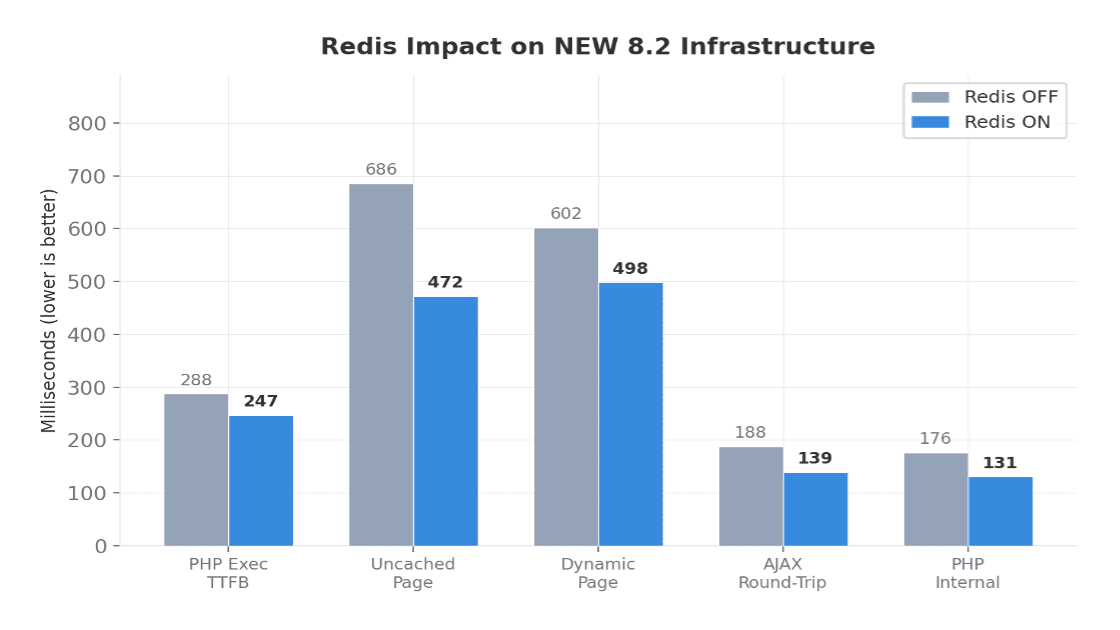
Redis dramatically reduces database load by serving repeated queries from memory. On the new infrastructure with PHP 8.2:
- Dynamic pages: 602ms → 498ms (17% faster)
- AJAX round-trip: 188ms → 139ms (26% faster)
- PHP internal: 176ms → 131ms (26% faster)
Redis is not primarily about making a single request faster.
It’s about ensuring the platform stays fast under heavy concurrency.
PHP 8.2 vs PHP 8.5 on the New Infrastructure
Good news if you’re planning to move clients to the latest PHP version:
| Test | PHP 8.2 | PHP 8.5 | Difference |
| PHP Execution TTFB | 288ms | 286ms | Equivalent |
| WP PHP Internal (Redis ON) | 131ms | 131ms | Equivalent |
| AJAX Round-Trip (Redis ON) | 139ms | 139ms | Equivalent |
| Uncached Page | 686ms | 589ms | 14% faster on 8.5 |
| Cached Page | 3.1ms | 3.6ms | Within margin |
Performance is virtually identical. Go ahead and upgrade to PHP 8.5 for security patches and language improvements — there’s zero performance penalty.
What You Should Expect From This Upgrade
You should expect to see:
- Faster dynamic page generation
- Faster backend responsiveness
- Faster AJAX interactions
- Dramatically faster cached responses
- Improved consistency under load
- Fewer performance spikes
This happens because:
- PHP workers free up faster
- Requests queue less frequently
- Database pressure decreases
- Request scheduling is more efficient
In simple terms:
WordPress spends more time working and less time waiting.
This Upgrade Was About Infrastructure — Not Just PHP
Most hosting upgrades focus on one thing:
“We upgraded PHP.”
But that’s not where most WordPress performance problems actually occur.
We redesigned the entire execution pipeline, including:
- PHP execution
- Worker orchestration
- NGINX delivery
- Networking efficiency
Without changing plugins or code:
- Response consistency improved
- Cached delivery became dramatically faster
- Scalability headroom increased
Most hosting companies optimise for speed tests.
We optimise the entire execution layer — because that’s where WordPress sites either feel fast or fall apart.
Why This Matters for Agencies
Agencies don’t care about benchmarks.
They care about:
- Sites surviving traffic spikes
- Stable WooCommerce checkouts
- Fewer worker-limit incidents
- Faster admin experiences
- Less firefighting
- Faster loading sites and SEO benefits
That’s exactly what this upgrade was designed to deliver.
Future Plans
This infrastructure upgrade wasn’t just about speed — it was about building a foundation we can move fast on.
With the speed and performance improvements completed, we’ll be turning our attention to the Staq dashboard — reworking the UI and UX to make site management smoother and more intuitive. The new architecture also means we can ship features significantly faster than before.
And there’s something else we’re working on that we’re not quite ready to announce yet — an AI project specifically designed to help digital agencies build and manage websites on our platform. We’ll have a lot more to share on this soon.
Exciting times ahead.
Final Thought
Performance isn’t one thing.
It’s the combination of:
- Infrastructure
- Execution efficiency
- Worker availability
- Stability under load
These benchmarks validate what we’ve been building toward:
A faster, more scalable WordPress platform — engineered from the inside out.
If you’re already on WPStaq, you’ll begin benefiting from these improvements as the rollout continues.
And if you’re curious what this platform could do for your agency’s sites — we’d love to show you.
Book a call with one of our engineers and we’ll walk you through it. 🚀
See it for yourself.
Create a WordPress environment in 60 seconds. Migrate your first site free. 400+ agencies already made the switch.
